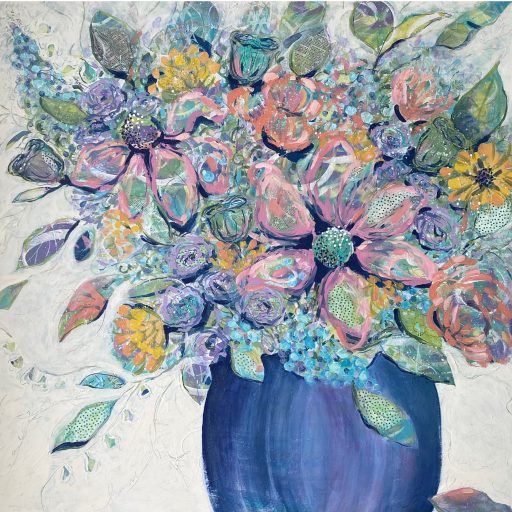
“Taking a line for a walk”
Paul Klee
Paul Klee (1879-1940) was a Swiss-born artist whose works are found in major museums around the world. As I dive deeper into art, artists, and art history, I’ve come across his words, “taking a line for a walk,” many times. It sounded like a lovely way to draw yet, sadly, my studious, mechanical lines never matched his spirited encouragement. Klee is described as a “natural draftsman,” in other words, he could draw and draw well. He was an instructor at the influential Bauhaus School (for artists) in Germany and his lectures were published in his Pedagogical Sketchbook (1925). “Taking a line for a walk” is excerpted from that book. Yet, as proficient as he was at his craft, his quote was and is meant to motivate those who draw to embrace more freedom in their work. It suggests that drawing need not be a laborious process but rather a joyful exploration, where the line moves along on a spontaneous journey, rambling haphazardly down the scenic route rather than barreling straight toward the destination (his drawing, “Garden” (1910), is in the Museum of Modern Art in New York City). His words inspire carefree playfulness over rigid exactness, joyful artistic expression over painstaking meticulous representation. I loved the concept but, hard as I tried, I struggled to emulate it in my own work.
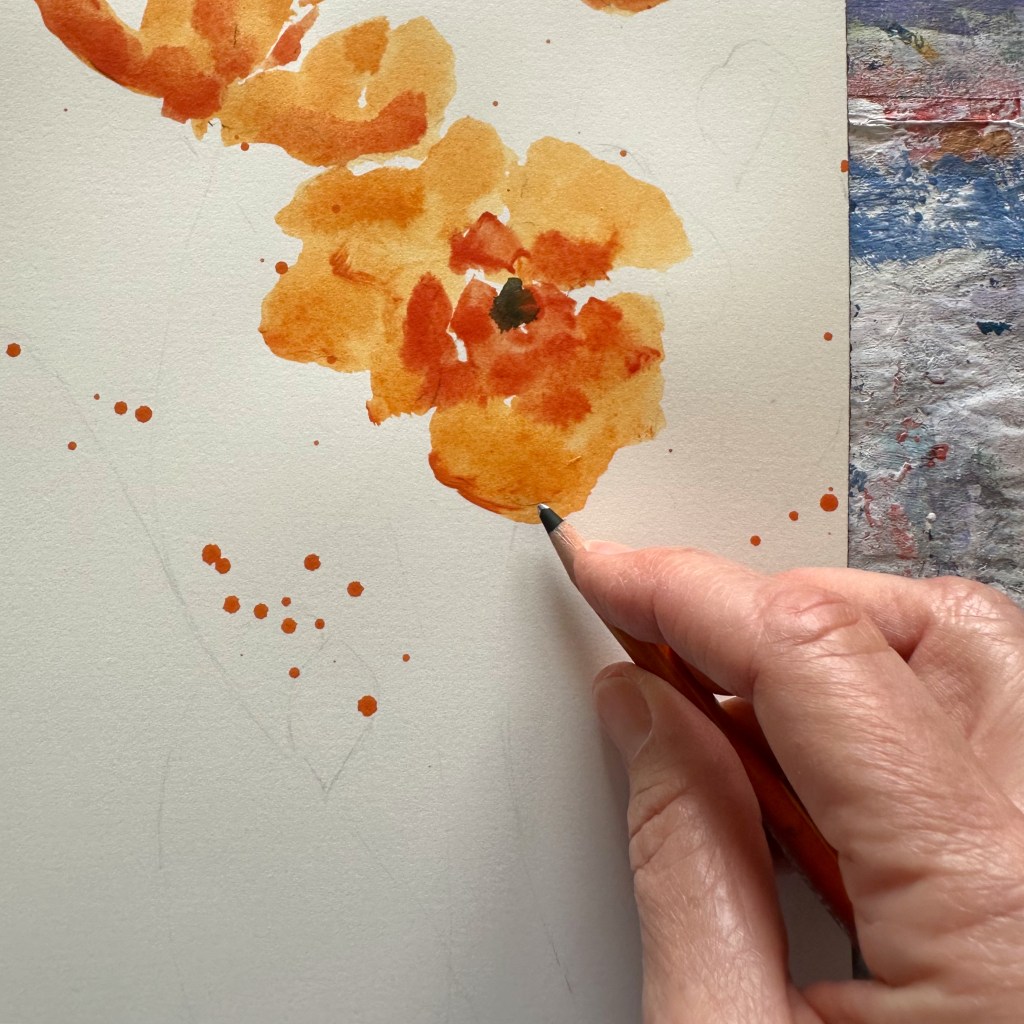
It wasn’t until I discovered the lovely artist (and human), Rebecca Sower, and enrolled in one of her online classes that I began to find my way to the expressive drawings I yearned to make. The key, as simple as it may sound, was to hold my pencil differently (below left). This tiny tweak allows me more freedom to twist my hand and wrist, varying the pressure while I “walk” my graphite or charcoal lines. On scrap paper, I practiced drawing imperfect, loose, “lost and found” lines, playing with their possibilities. Oh my, were they interesting! Finally, I felt like I was “taking a line for a walk,” a glorious saunter around the page. I’d found the style I’d been chasing for years, and I was hooked!
Last month, at a meeting of our Outdoor Art Group, I listened to a few artist friends lamenting; they wanted to draw “looser” but couldn’t figure out how. “How do you hold your pencil,” I asked? You would’ve thought I’d asked if the world was flat, they looked at me as if I was crazy! Many of them create meticulous color pencil drawings, often of birds, and hold their pencils like we were all taught in school (below right), like they are writing. Their work is beautiful! But it is also tight, more concerned with accuracy of form than expression. That’s ok, many people prefer art that is an exact representation. However, Impressionism flourished in the years just after the camera was invented, when artists no longer needed to recreate an image in exact detail, like a photograph. They chose instead to paint or draw, to express, how a subject made them feel, not just how it looked. I could tell that’s the direction my art friends were hoping to move, and it led to an interesting discussion on, of all things, the way we hold our pencils.
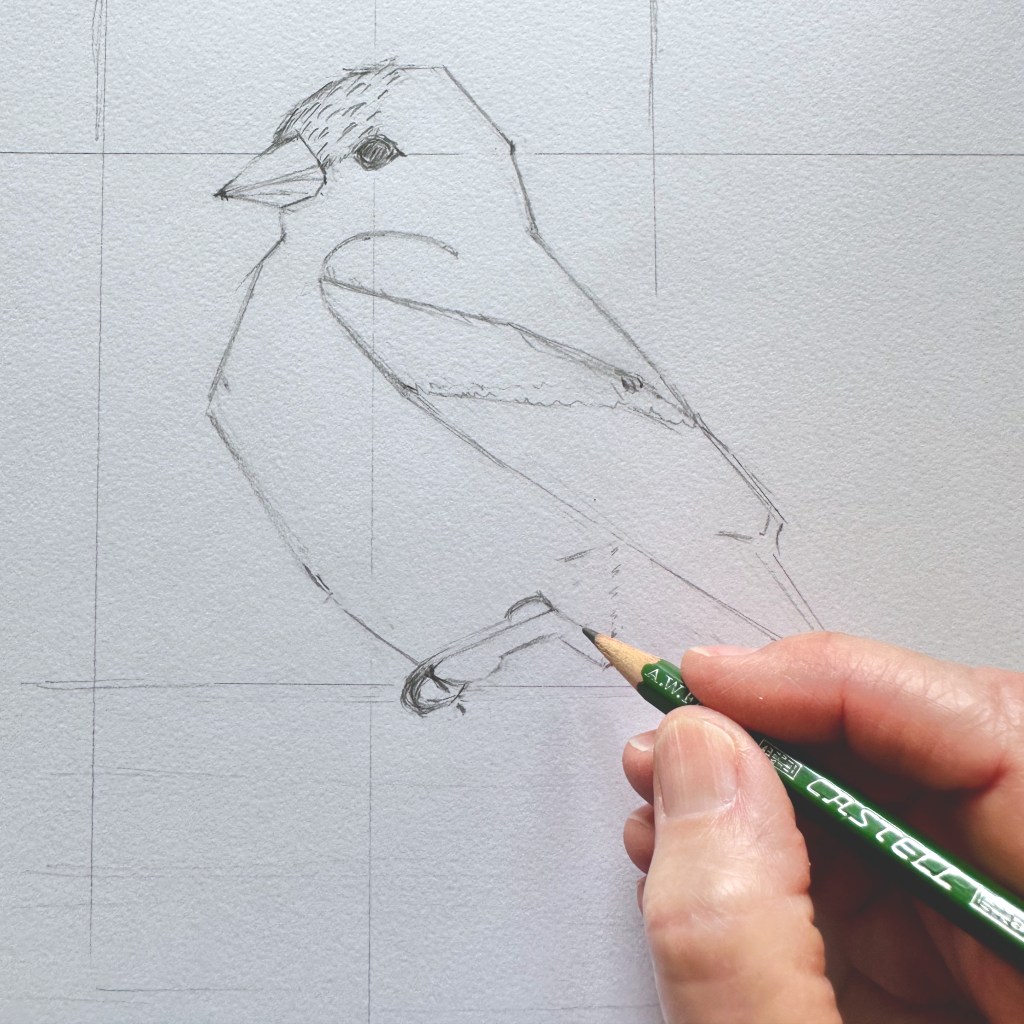
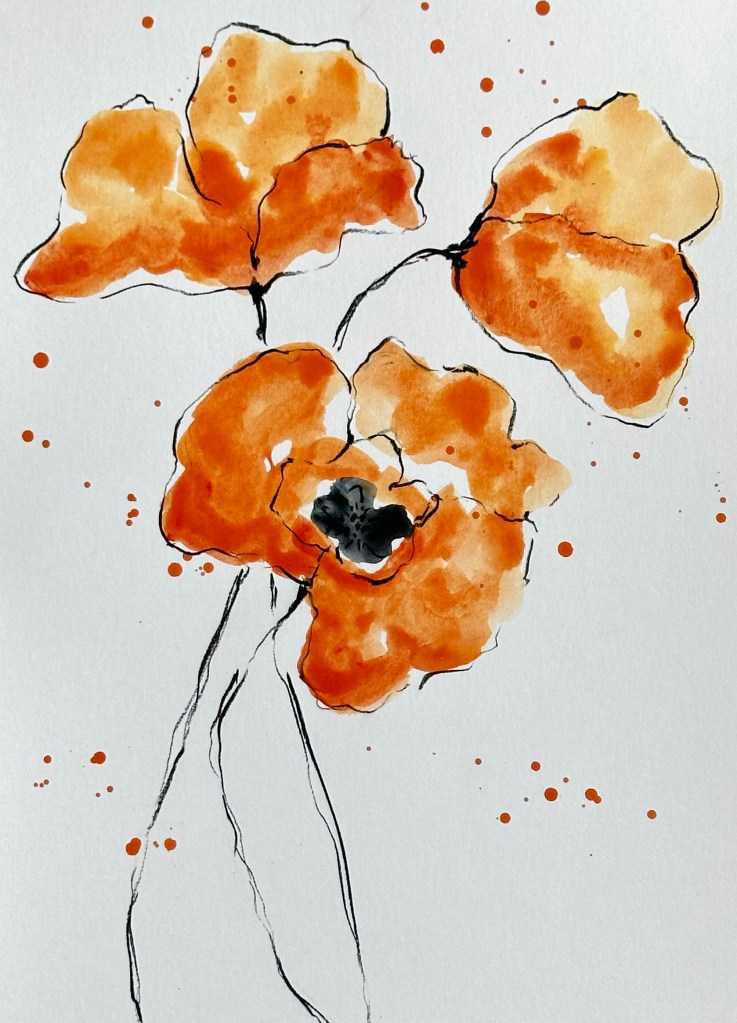
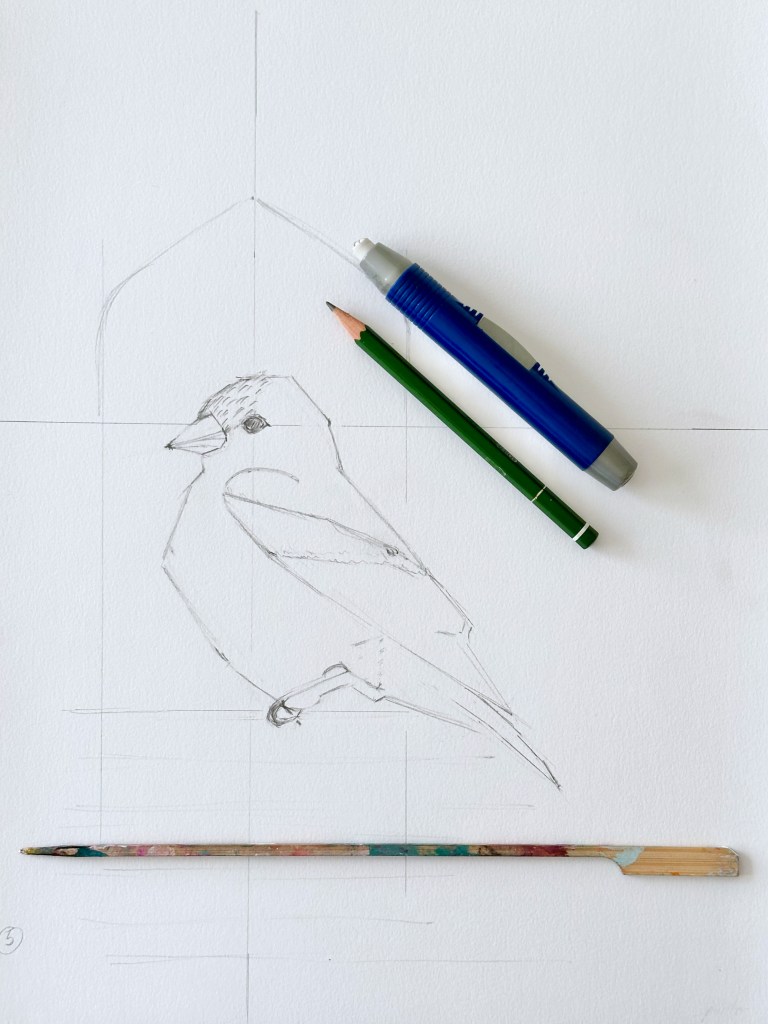
Whenever I tell people I’m learning to paint they inevitably laugh and say, “oh, I could never be an artist, I can’t draw!” Well … truth be told, neither can I. When I set out to draw something, to copy its likeness, I use the tools in the photo below. I draw a horizontal and vertical axis through my reference photo, with the crosshairs at the focal point, in this case, the bird’s eye. I draw the same axes on my paper, and I painstakingly measure distances and angles, gradually “finding” the perimeter and interior landmarks until I think I’ve got it. Often, I don’t have it, and so I erase, A LOT. Drawing, like writing, is more about editing than mark-making. It’s a constant process of reworking and revising. Truthfully, I don’t enjoy this kind of drawing. If I’m patient enough to spend the time necessary, I can usually render a decent image, but there’s no joy for me in the journey of those precise lines. Drawing in this way is a labor, not a love. Perhaps that’s why my favorite subject material is flowers rather than birds, there is no eye that MUST be in the right place, and in the right relationship to the beak, and the wing, and the tail, good grief, proportion is so fussy! I do enjoy the challenge of drawing something “hard” (birds, hands, faces) from time to time, but it feels exhaustingly academic, and I soon find myself back to my charcoal pencil, holding it “funny” and happily drawing imperfect, meandering lines like those in my poppies (featured image above). My art yearns for expression not exactness, freedom not rules.

It’s summer in Happy Valley and the flowers are in full bloom. I invite you to take a pencil (any kind) and a notebook (the cheaper the better) outside, like I did this morning. Find a comfortable spot in the shade, inhale the beauty of all that surrounds you, and practice. Hold your pencil like you’re an artist, not a student. Take a line for a walk … allow it, and yourself, to see and discover, wander and find, experiment and express. Don’t worry if you’re doing it right or what it looks like, simply notice how it feels. Good, right?
See, you can draw!
 Melissa Stephens Art
Leave a comment