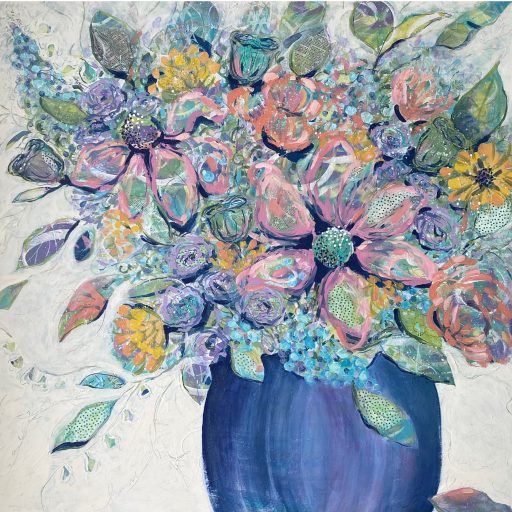
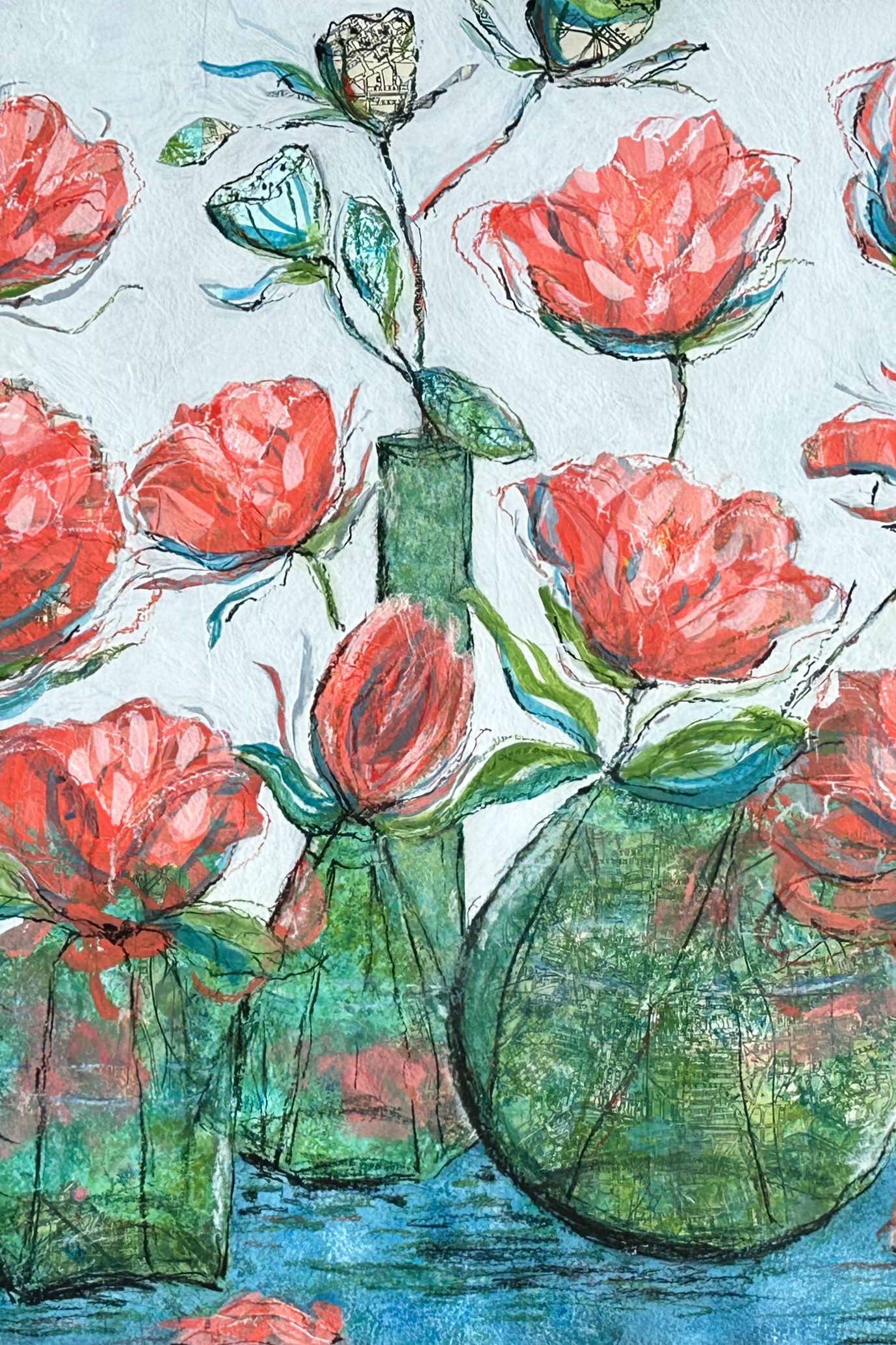
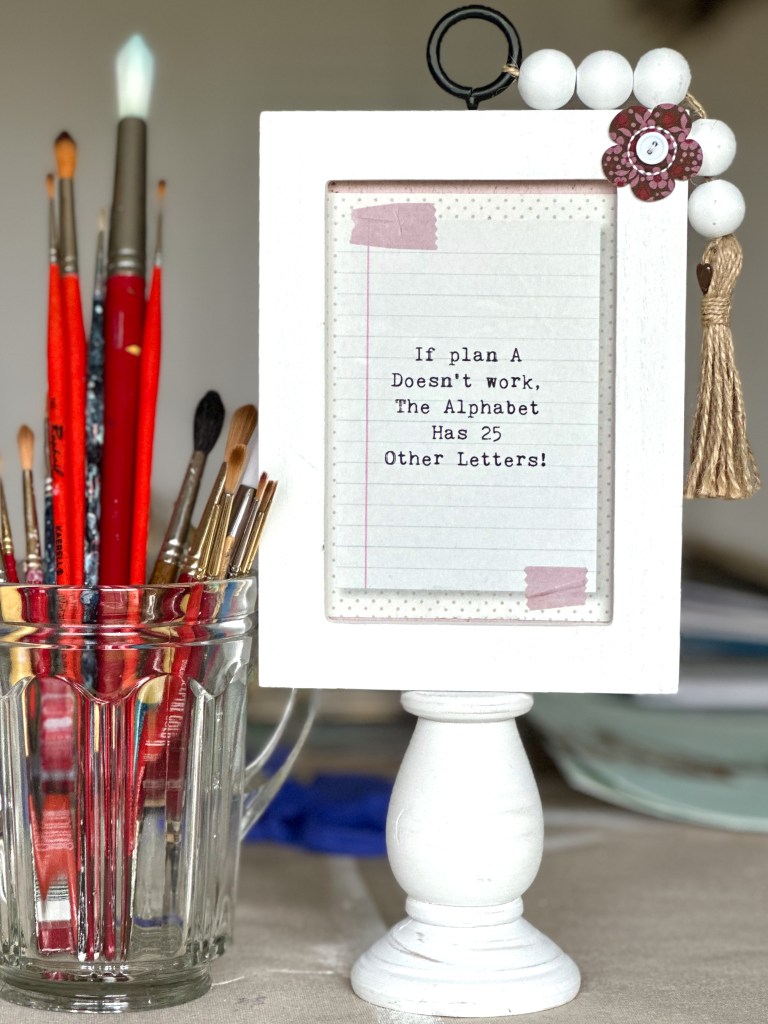
Years ago, when scrapbooking was my creative outlet, once or twice a year I would spend the weekend with a small group of friends in a craft store north of Pittsburgh. One of those women was an unrelenting perfectionist. If she could not find the perfect shade of seafoam green paper or decide which photos to include on a layout or, heaven forbid, made a mistake in cutting or gluing, she would abruptly stop and put the entire unfinished page away. She described having stacks (well over 50 at that time!) of unfinished pages she’d started but never completed because of some creative roadblock encountered on her path to perfection. The moment she got stuck, the page immediately went onto her purgatory pile, waiting in limbo … for the perfect piece of patterned paper or the perfect embellishment because, if it couldn’t be perfect, couldn’t be exactly how she had envisioned it at the start, then it couldn’t be finished, and couldn’t be put in her album. At some point, over the years of observing her repeatedly paralyzed by her need for perfection, I came upon a tear-out card in a Flow magazine that said, “If plan A doesn’t work, the alphabet has 25 other letters!” I placed it in the middle of my work table at home and adopted it as a mantra. Years later it’s now in a cute little frame, still prominently displayed in my line of sight as a gentle yet powerful reminder (image below.) For I, alas, can also be a perfectionist. Yet, as I watched my friend falter in the creative process time and time again, I saw what a potent poison perfectionism can be, and I vowed to not be another one of its victims. I had so many photos and so many stories to tell from our family’s life, I didn’t have the time nor energy to make them all perfect. When I hit a roadblock or made a mistake (frequently), I found a work-around, a plan B (or a plan Q!). I chose to see my inevitable blunders as creative opportunities and kept moving forward to finished pages, stories told, memories captured, and albums filled. None of them are perfect, but all of them are good enough. For I always understood the sum was greater than the parts; an album full of completed pages we could enjoy looking at together as a family was far more important than any single “perfect” page (and a mammoth pile of unfinished ones no one will ever see because they’re stuffed in a plastic bag on a folding table in the corner of a spare room.)
My own dance with perfectionism started early in life and it’s only now, at almost 60 (!), I’m doing the work to find a few new psychological dance partners. Yes, it was a trait that served me well during fast-paced, 12 hour shifts in the emergency room when I needed to sift through the complex details of multiple patients at once, constantly on “high alert” for any mistake that could prove catastrophic. But it no longer serves me now, and so I’m attempting to unlearn it as the bedrock foundational core of my personality. Two years ago, as part of my self-constructed 12-step perfectionism recovery program, I spent a few delightful weeks writing in my journal, naming and describing all the weird and wacky voices in my head. Prior to that those voices ran my cerebral show, clamoring all hours of the day and night to be heard. Their cacophonous chatter of negative, self-critical thoughts had become my soundtrack, my identity; they had become “me.” What a relief the day I realized; I don’t have to listen to them! I’ve been pleasantly surprised to find that, by naming and acknowledging all the voices in my head, I am now able to see them for what they are … thoughts, unsolicited, unhelpful, and unfiltered thoughts. They are not the gospel truth of who I am. In fact, they are terribly judgmental & demeaning, not who I want to be at all. While I can’t surgically remove them from my psyche, I can consciously move them from their former front copilot seat in my brain to the back of my cranial car and ask them, politely, to SHUT UP (no back seat drivers allowed!) Sure, I appreciated their desire to protect me from the shame and embarrassment of mistakes large and small earlier in life, but I no longer need to hear their non-stop admonishments in my studio, nor my living room, nor my kitchen, nor anywhere really. Of those voices, Perfect Pearl has always been the loudest and she is a stickler, a joy-sapping, control-freaking, all-consuming tyrant! She’s been so firmly entrenched in my white matter that she’s tough to wrestle to the back seat and tougher to mute. But I’m trying, learning ways to pay less attention to her incessant chatter and, instead, accepting and embracing a revolutionary concept for me, good enough. I’m good enough. What I do and think and say is good enough. I allowed my scrapbook pages in the past to be good enough, and now I’m looking to adopt those 2 words in the rest of my life as well. Pearl HATES this new me, but I love it, suffice it to say the two of us are still trying to work out our differences. It’s important for my overall health and well-being and it’s also important for my art; for what I’m hoping to capture in my drawings or paintings is not a perfect, exact representation of a flower, I have my camera for that. Instead, I’m hoping to convey how that flower makes me feel, how it’s grace and beauty, color and form make me pause, smile and say, “wow, that’s amazing!” I’m trying to paint the delight I see in a world that is, in the end, incredibly imperfect. For, as Rick Rubin says in his book, The Creative Act: A Way of Being, “The goal of art isn’t to attain perfection. The goal is to share who we are. And how we see the world.” Even as I type these words, I can feel Pearl in my neural synapses rolling her eyes and saying, “really?” Yes, Pearl, really!
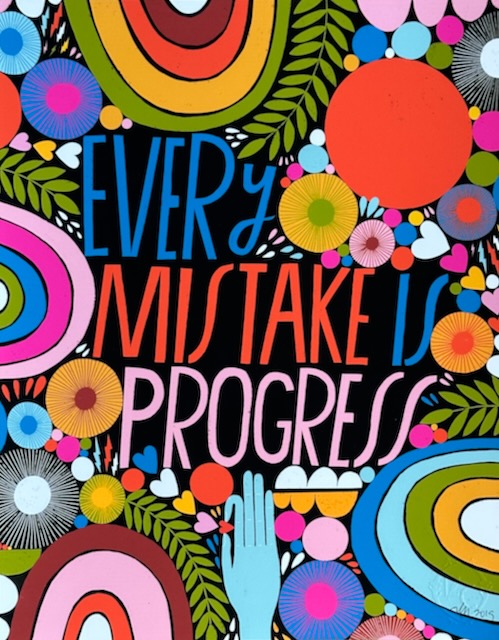
Julia Child, famous chef, author, and television personality provided tips and lessons on how to prepare French food simply and easily. She was a professional creative, and her canvas was her kitchen. As someone who’s creative realm has NEVER been my kitchen, I haven’t watched her shows nor read her books, but she always struck me as a polished, exacting perfectionist. Therefore, when this delightful video arrived in my inbox as part of a weekly newsletter from artist and Draw Together founder Wendy MacNaughton, I chuckled out loud. It features THE Julia Child totally botching her attempt to flip a potato dish in a skillet on television no less. After watching, I felt a kinship to her, not as a fellow cook but as a fellow creative. For anyone who tries to create, to make something, makes mistakes ALL THE TIME. The lesson in this short video is simple: perfection is NOT the goal. Whenever we try to make anything, whether we’re flipping potatoes or painting a poppy, as Julia says, “you just have to have the courage of your convictions” to try. For, she continues, “the only way you learn how to flip things is just to flip them.” Similarly, the only way you learn how to paint poppies is just to paint them, lots and lots of them. Another encouraging phrase (image below) I have on my studio wall is by the artist Lisa Congdon and it says: Practice Makes Progress! YES! Practice does not make the ever-elusive perfect, but it can, in time, make progress.
Thank goodness the goal is not perfection because holy smokes, I’m falling short of that ideal A LOT right now! I haven’t painted anything I’ve loved (or even liked) in months. I’m at Plan M and I’m still struggling. Thankfully there’s N, and O, and P … I can turn my paper over and begin again. It may sound crazy but, despite my recent struggles, I’m still wholeheartedly enjoying myself. The hours I spend creating; my almost daily attempts to capture what I feel, see, and love in paint and on paper; are often the best hours of my day. One of my favorite artists Amanda Evanston, whose online classes inspired me through the pandemic years says, “joy and perfection never live in the same place.” I could put every painting I’ve made recently onto a large pile labeled “failures” and give up but I’m having too much fun to succumb to the negative chatter in my brain. Perfect Pearl’s chirping quite a bit again from the backseat, unabashedly pointing out my countless flaws. Her chorus has been joined by her good friend and ally, Practical Prudence, who’s admonishing me for wasting paint and paper, time and money. I take a deep breath (sometimes several), turn the music up in my studio to drown out their voices, and re-read the card on my studio table, “If plan A doesn’t work …” I remind myself of the words of Thomas Edison, “I have not failed, I’ve just found ten thousand ways that won’t work!” I remind myself of my friend in Pittsburgh struggling to make perfect pages. I remind myself how much I enjoy making art, even when I make a mess. I remind myself every mistake is a creative opportunity. Joy and perfection don’t live in the same place. There are more letters in the alphabet. Julia Child says, after her potato flip debacle, “Anytime anything like this happens, you haven’t lost anything because you can always turn it into something else.” Her video humorously teaches us what we need to understand about creativity and life: we will always be beginners, we need to have courage, we will make mistakes, we can turn those mistakes into something else and, perhaps, that something else will be more beautiful or more delicious than anything we had initially planned. In cooking as in painting as in life, we do not need to be perfect. Rather, what we need is precisely what our creativity can teach us: resilience and patience and persistence; how to find joy in the process, not in the result. What I make today may not be good but, perhaps, if I show up in my studio again tomorrow, what I make then might bring a smile of satisfaction to my face and might bolster the tentative (but growing-in-confidence) voice in my head that says, like it did on my old scrapbook pages, “good enough.”

 Melissa Stephens Art
Leave a reply to jeannespin Cancel reply